When a Ship Sinks: Who Is Legally Responsible for the Lives Lost?

Updated: 4 days ago
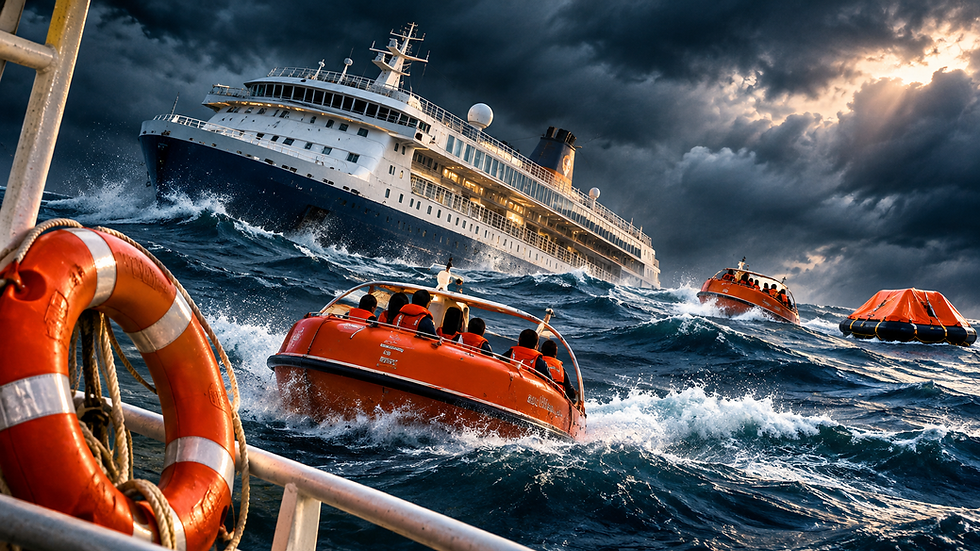
When a ship sinks, a ferry capsizes or two vessels collide at sea, the immediate priority is rescue. But after the emergency comes a difficult legal question: who is responsible for the deaths, injuries and losses? Was the vessel seaworthy? Was it overloaded? Were lifeboats and life jackets adequate and operational? Did the captain and crew respond properly? And who must compensate the families of those who lost their lives?
A maritime accident is not necessarily the fault of one person. Responsibility may involve the registered shipowner, charterer, manager, operator, master, officers, maintenance contractors and, in some circumstances, another vessel or a public authority. Maritime liability is examined through domestic legislation, international conventions, civil claims, insurance and, where justified, criminal prosecution.
1. Who is responsible when a ship sinks?
A sinking does not by itself prove negligence. Ships may be lost because of extreme weather, collision, fire, flooding, structural failure, machinery breakdown, navigational error or a combination of causes. The legal inquiry is whether a person or organisation breached a duty of care or a statutory obligation and whether that breach caused or contributed to the loss.
The shipowner and vessel operator
The owner has fundamental responsibilities for the vessel's seaworthiness, maintenance, statutory surveys and safety equipment. These include maintaining the hull, machinery and electrical systems; ensuring valid certificates; providing approved life-saving and fire-fighting appliances; employing qualified personnel; and observing passenger and cargo limits. The registered owner and the company operating the vessel may be different entities. A charterer, manager or operator may also have relevant responsibilities depending on its role and the applicable statute.
The captain, officers and crew
The master is in command of the vessel and has important duties concerning navigation, safety and emergency response. Potential failures include unsafe speed, ignoring weather warnings, inadequate lookout, failure to respond to flooding or fire, delayed evacuation and failure to send distress communications. Officers and crew may also be responsible for particular duties. Their conduct must be assessed in light of their training, instructions, authority and the circumstances of the emergency.
2. When two ships collide: who is liable?
The International Regulations for Preventing Collisions at Sea, 1972 (COLREGs) establish rules concerning lookout, safe speed, risk of collision, action to avoid collision, navigation lights, sound signals and conduct in restricted visibility. Breach of a collision rule may be important evidence when negligence is assessed.
Under the Merchant Shipping Act, 2025, Sections 153 to 159 address collision and related liability. Section 154 provides for apportionment according to fault. Where more than one vessel is at fault, responsibility is apportioned according to their respective degrees of fault. The Act also addresses loss of life and personal injury, contribution between vessel owners and the master's duty to assist after a collision. The injured person's claim and the later apportionment between shipowners are distinct legal questions.
3. International rules governing maritime safety
The International Maritime Organization (IMO), a specialised agency of the United Nations, develops international standards for shipping safety and pollution prevention. Several conventions work together to regulate the ship, its equipment, navigation and crew.
SOLAS – Safety of Life at Sea
The International Convention for the Safety of Life at Sea, 1974 (SOLAS), is a central international treaty on ship safety. It addresses construction, subdivision and stability, machinery and electrical installations, fire protection, life-saving appliances, radio communications, navigation and emergency procedures. Its requirements apply according to the vessel's type, size, voyage and relevant provisions; SOLAS does not impose an identical arrangement on every boat or vessel.
The LSA Code, STCW and the Maritime Labour Convention
The International Life-Saving Appliance Code gives technical requirements for lifeboats, liferafts, rescue boats, life jackets, lifebuoys, immersion suits, visual distress signals and launching appliances. The International Convention on Standards of Training, Certification and Watchkeeping for Seafarers (STCW) establishes minimum standards for seafarer training, certification, watchkeeping and emergency competence. The Maritime Labour Convention, 2006 addresses seafarers' employment conditions, accommodation, medical care, occupational safety, hours of work and rest and welfare.
4. Lifeboats: must every ship carry them?
The answer depends on the vessel and voyage. SOLAS Chapter III and the LSA Code prescribe survival-craft and life-saving arrangements for ships within their scope. The exact number, type, capacity and distribution depend on whether the vessel is a passenger ship or cargo ship, the number of persons carried, vessel characteristics, voyage and any permitted alternative arrangement or exemption.
For passenger ships covered by SOLAS, the applicable rules generally require survival-craft capacity for the persons onboard, with prescribed arrangements for lifeboats and liferafts. Approved combinations may be permitted in specified circumstances. Cargo ships are subject to a separate set of requirements, which may include totally enclosed lifeboats or an approved free-fall lifeboat arrangement together with prescribed liferaft capacity.
A lifeboat is a rigid survival craft, commonly with independent propulsion, intended to carry people away from a vessel in distress. A liferaft is a floating survival craft that may be inflatable or rigid and is designed to support occupants while awaiting rescue. They are not interchangeable unless the applicable regulations permit the approved arrangement. Life jackets are personal flotation devices intended to help keep a person's airway clear of the water. Ships must carry the prescribed number and types, including appropriate provisions for children and infants where applicable.
Other life-saving appliances may include lifebuoys, immersion suits, thermal protective aids, distress flares, rescue boats, launching appliances, marine evacuation systems, alarms and public-address systems. Their availability, location, condition and accessibility matter as much as their presence on the inventory.
5. Inspection, maintenance and emergency drills
SOLAS requires operational readiness, inspection, maintenance and drills. Lifeboats may be useless if launching appliances or release mechanisms are defective, equipment is inaccessible, or the crew does not know how to deploy it. Maintenance arrangements include examination of survival craft and launching appliances, servicing, testing, overhaul and repair. SOLAS amendments effective from 1 January 2020 strengthened requirements in this area, partly to prevent accidents during lifeboat drills and maintenance.
SOLAS Chapter III Regulation 19 addresses emergency training and drills, with additional provisions for passenger ships. Crew members must know their assigned duties, muster arrangements, survival-craft operations and evacuation procedures. Equipment without trained people and practiced procedures is not an effective safety system.
6. What if a ship sails without adequate safety equipment?
The investigation should ask whether the vessel was required to carry particular appliances; whether they were carried, approved, maintained and accessible; whether capacity matched the persons onboard; whether the crew was trained; and whether statutory surveys and certificates were valid. A regulatory breach and liability for a particular death are related but separate questions. Defective lifeboats may not have caused a ship to sink, but they may have contributed directly to deaths by preventing effective evacuation.
India's Merchant Shipping Act, 2025 is supported by subordinate rules, including the Merchant Shipping (Life-Saving Appliances and Arrangements) Rules, 2026, issued on 27 July 2026, alongside rules on survey, audit, certification and safety management. The applicable Gazette text and any amendments should be checked for the vessel and voyage in question.
7. India's Merchant Shipping Act, 2025
The Merchant Shipping Act, 2025 was enacted on 18 August 2025 and came into force on 15 March 2026, replacing the Merchant Shipping Act, 1958. It is the central statutory framework for Indian merchant shipping, read with the applicable rules and international obligations.
Sections 153 to 159 address collision, apportionment of liability, personal injury and death, contribution between owners and assistance after collision. Sections 162 onwards deal with limitation of liability for maritime claims. Section 166 concerns the limit of liability for claims arising from passenger death or personal injury, with the applicable limit to be read with the prescribed rules. These provisions do not create one automatic compensation amount for every accident.
Section 163 is important to the limitation framework: a person may lose the right to limit liability where the loss resulted from that person's own personal act or omission, committed with intent to cause the loss or recklessly and with knowledge that the loss would probably result. Section 172 addresses compulsory insurance or other financial security for relevant maritime claims. The statutory text and applicable rules must be examined before calculating any limit or entitlement.
8. Can passengers and families claim compensation?
Depending on the facts and applicable law, passengers or their legal representatives may pursue claims for death, personal injury and other legally recoverable losses. The basis may arise under the Merchant Shipping Act, applicable international conventions, contract, negligence principles or other relevant legislation. The vessel's flag, location, voyage and nature of carriage can affect which regime applies.
For a death claim, relevant issues include whether the vessel was seaworthy, whether the operator complied with safety requirements, whether the master or crew acted negligently, whether emergency arrangements were adequate, whether a breach contributed to the death and what losses are legally recoverable. Survivors may have claims for physical injury, disability, medical expenses, loss of income and rehabilitation costs. Crew members may have separate rights under employment arrangements, maritime labour legislation, insurance and applicable compensation laws.
Useful evidence may include tickets and booking records, passenger manifests, vessel registration and certificates, survey and maintenance reports, crew qualifications, navigation and voyage data, radar and communication records, witness accounts, photographs, video, investigation reports, insurance documents, medical records and death certificates.
9. The Athens Convention and passenger protection
The Athens Convention relating to the Carriage of Passengers and their Luggage by Sea, 1974, and its 2002 Protocol establish an international framework for passenger death, personal injury and luggage claims. Under the 2002 Protocol, liability for death or personal injury arising from a shipping incident is generally subject to a strict-liability regime up to 250,000 Special Drawing Rights (SDR) per passenger for each distinct occasion, with potential liability up to 400,000 SDR unless the carrier establishes the relevant defence. The Protocol also provides for compulsory insurance or other financial security.
These limits are not a universal compensation schedule for every ship accident. Treaty status, national implementation and scope of application must be established. The Convention should not be assumed to apply automatically to every domestic voyage in India.
10. Can the captain or shipowner face criminal prosecution?
Civil compensation and criminal responsibility are separate. Criminal proceedings may be considered where evidence points to criminal negligence, reckless conduct, deliberate safety violations, falsified certificates, knowingly operating an unsafe vessel, disabling safety equipment or other offences. In India, the Bharatiya Nyaya Sanhita, 2023, including Section 106 on causing death by negligence, may be relevant where its ingredients are established, alongside applicable maritime offences.
Not every fatal maritime accident proves criminal negligence. The prosecution must establish the elements of the offence and the required causal connection. The question of who must compensate victims is not necessarily the same as the question of who should be prosecuted.
11. Who investigates a maritime disaster?
The authority and process depend on the vessel, flag, location and applicable law. India's Directorate General of Shipping has an important role in merchant-shipping regulation. An investigation may examine the hull, stability, loading, machinery, fire systems, life-saving appliances, weather, navigation, communications, passenger numbers, crew training, certificates, surveys and maintenance records.
A technical marine casualty investigation seeks to establish causes and safety lessons. A criminal investigation determines whether an offence has been committed. A civil proceeding determines rights and liabilities. These processes may run separately or alongside one another. A technical report can provide important evidence but does not automatically determine civil or criminal liability.
12. Can regulatory authorities also be responsible?
Where a vessel was certified despite serious defects, or inspection and enforcement failures contributed to a disaster, the conduct of the relevant authority or inspection body may require scrutiny. But government authorities are not automatically liable for every accident. A claim requires examination of the applicable statutory duty, the authority's conduct, the legal principles governing public liability and the causal connection with the loss. A certificate is a regulatory safeguard, not an unconditional guarantee against accidents, and it does not erase the owner's obligations.
13. What should passengers know before boarding?
Passengers should identify emergency exits and the designated muster station; locate life jackets and understand how to put them on; pay attention to safety briefings; follow crew instructions; keep evacuation routes clear; raise concerns about apparent overcrowding, blocked exits or visibly defective safety arrangements; and report safety deficiencies to responsible personnel or appropriate authorities.
14. Can a shipowner simply call it an accident?
No legal analysis can stop at the word accident. If a vessel is lost because of an extraordinary and unavoidable natural event, despite compliance with legal duties and reasonable precautions, liability may not arise merely because the ship sank. But if the vessel was overloaded, unseaworthy, inadequately equipped or operated in disregard of known risks, the weather alone may not answer the legal question.
The investigation must distinguish the cause of the sinking from the causes that increased the loss of life. A defective lifeboat may not have caused the initial emergency but may have made evacuation impossible. The law therefore examines both the event and the measures taken to protect those onboard.
Conclusion: A ship carries human lives, not merely passengers
Ships carry cargo and connect economies, but they also carry people who depend on the condition of the vessel, the competence of its crew and the effectiveness of its safety arrangements. When a vessel sinks, the law may require scrutiny of the owner, operator, master, crew, contractors and, in appropriate cases, regulatory oversight.
SOLAS, STCW and COLREGs provide important international safety standards, while India's Merchant Shipping Act, 2025 and the rules made under it establish the domestic statutory framework. Their purpose is not simply to regulate paperwork. They are designed to protect human life before an emergency occurs.
A lifeboat is not merely a piece of equipment on a ship. It represents a legal and moral obligation to protect human life. A vessel carrying passengers must be prepared not only for the voyage, but also for the possibility that the voyage may end in an emergency. When preventable failures result in deaths at sea, the question of legal responsibility must never be ignored.
Legal references and further reading
Merchant Shipping Act, 2025 – India Code: https://www.indiacode.nic.in/
Directorate General of Shipping: https://www.dgshipping.gov.in/
International Maritime Organization – SOLAS: https://www.imo.org/en/OurWork/Safety/Pages/Default.aspx
IMO – STCW Convention: https://www.imo.org/en/OurWork/HumanElement/Pages/STCW-Convention.aspx
IMO – COLREGs: https://www.imo.org/en/About/Conventions/Pages/COLREG.aspx
Legal note: This article is for general legal awareness and educational purposes. The application of maritime conventions, domestic legislation, limitation of liability and compensation provisions depends on the vessel, flag state, nature of voyage, location and circumstances. Specific claims require examination of the applicable law, current rules and evidence.
Subscribe to the ALI Legal Brief
Receive selected legal analysis, public-policy insights and perspectives on emerging legal developments from Ambat Legal Insight.
Subscribe: https://www.ambatlegalinsight.com/newsletter-subscription
Comments